The Layers Inside a County Place Name
Learn how a county place name can hint at language, landscape and settlement, while keeping maps, records and local evidence in view.
On a damp morning, a walker pauses at a county lane sign reading “Aldercombe” and wonders why the village has that name. A county place name may hold clues to an older language, a feature of the land or a pattern of settlement, but no single word can tell the whole story. Its parts are invitations to investigate, not a ready-made history.
To see how those clues can be handled carefully, imagine a wholly invented village called Aldercombe, set in a fictional county. The name is not drawn from a real place, and the account below is not a claim about any actual settlement. It offers a way to think through possibilities while keeping evidence and speculation distinct.
Reading Aldercombe
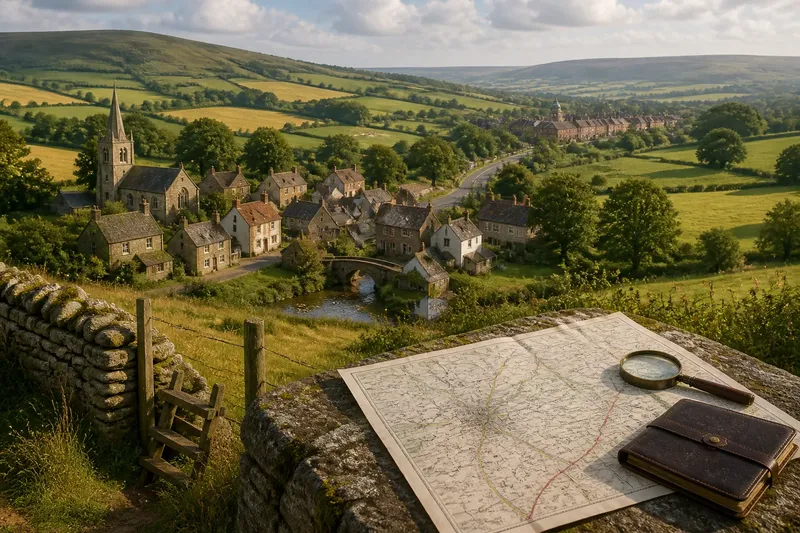
Imagine that an old county gazetteer lists Aldercombe beside a stream and a wooded slope. A modern map shows the village on rising ground, with fields stretching towards the water. The name seems to divide neatly into “alder” and “combe”, and a reader might be tempted to conclude that alders grew in a valley where the village began.
That is a plausible first reading, not a settled explanation. “Alder” looks like a tree-name in English, while “combe” is used in some English place names for a valley or hollow. Yet the spelling may have changed, the word boundaries may be misleading, or one part may have entered the name through a form no longer familiar to local speakers.
The first useful task is to write down the observation without turning it into a conclusion: the name resembles two recognisable elements, and the settlement lies near water and sloping ground. Keeping those statements separate makes it easier to notice when a later source supports one reading, weakens it or points elsewhere.
Start with the name as it appears, then ask what evidence could test each part.
Language in the spelling
Place names often outlast the everyday speech that shaped them. A name can carry sounds or word elements from an earlier language, then be adjusted by later speakers to fit new pronunciation and spelling habits. County names and village names may therefore contain layers that do not share one origin.
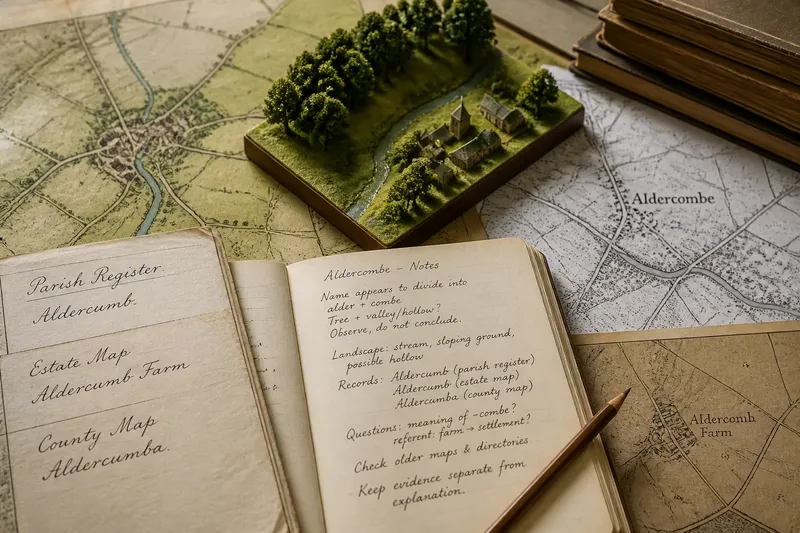
Suppose Aldercombe appears in an old parish register as “Aldercumb”. That imagined spelling would be useful because it resembles the modern form while offering a clue about how a clerk heard or recorded the name. It would not establish a definitive pronunciation, nor prove that the modern division into “alder” and “combe” was present from the beginning.
Written forms need context. A clerk might use a spelling that reflects local speech, a familiar word, a copying error or a convention used in the record. If the same name appears in several sources, compare the forms rather than selecting the one that best fits a favoured explanation. Changes in vowels and endings can matter, as can the possibility that two forms refer to different nearby features.
For Aldercombe, imagine that a second fictional document gives “Aldercumb” and a third gives “Aldercumba”. The variation invites questions: is the ending part of an older word, a grammatical form, or simply inconsistent writing? The records do not answer that by themselves. They help narrow the questions that a specialist dictionary, local archive or place-name study might address.
Landscape as a clue
A name may refer to a visible feature: a stream, ridge, marsh, wood, crossing or particular kind of ground. Such terms can preserve a description even after the feature has altered or disappeared. Drainage, farming, building and tree loss can leave a modern landscape looking unlike the one that first made a name meaningful.
In the invented Aldercombe, the stream and slope make a landform reading worth considering. A field map or older map might show whether the settlement sits in a hollow, beside a wooded area or near a bend in the water. The relevant feature might not be beside the present village centre; the name could refer to a wider tract or a former settlement site.
Still, resemblance is not confirmation. Alders can grow in damp places, but their presence near a stream would not prove that the name refers to them. A valley-like setting would likewise fit “combe” without showing that the element had that meaning in this particular name. The landscape can make an interpretation more or less plausible, but it cannot settle the linguistic question alone.
Look for the named feature on older maps as well as on the ground.
Settlement and movement
Names can preserve traces of how people used or organised a place. An element may suggest a farm, enclosure, crossing, meeting place or group of dwellings; another may point to an owner, community or activity. The name may have belonged to a farm or landholding before it came to identify a village, or it may have shifted from a stream or valley to the settlement beside it.
Imagine that a fictional estate map marks “Aldercumb Farm” away from the present village, while a later county map applies “Aldercombe” to nearby houses. That sequence could suggest a shift in the name’s referent from a farm to a settlement. It would not, by itself, establish when people first lived there or why the farm received its name.
To explore settlement, compare different kinds of records. Parish documents may show institutions and local administration; estate plans can identify farms, fields and landowners; maps can reveal changing roads and settlement patterns. Each source has its own purpose and gaps. A map made to show property boundaries may omit small dwellings, while a register may record people without describing where they lived in detail.
Place-name elements can also migrate. A stream might lend its name to a farm, which later lends it to a village, or a settlement might give its name to a lane. That possibility matters because a feature visible today may not be the one that first carried the name.
What evidence can establish?
The imagined Aldercombe investigation now has three strands: a name with apparently familiar parts, a landscape that could fit those parts and records that might show a change in how the name was used. None is conclusive on its own. Together, they make a more disciplined account possible, provided the account says clearly which points are observed and which remain uncertain.
Say you are considering whether “combe” names a hollow. You note the village’s position on a slope, then find an older map showing a small valley nearby. You compare the recorded spellings and discover that they do not consistently divide the modern name as expected. The reasonable result is not a dramatic origin story: the landform reading remains plausible, but the spelling evidence leaves the name’s earliest structure unresolved.
This kind of restraint is not a failure to interpret. It is a way to keep several explanations available until sources distinguish between them. A place-name specialist may be able to assess historical forms and language more closely; local records and maps can help establish how the name was applied over time.
- Record the current form: note the spelling on signs, maps and local records, and keep variations rather than silently standardising them.
- Find older forms: check accessible parish, estate or county records, noting the source and its date as recorded there.
- Locate the name: compare the settlement with streams, slopes, woods, crossings and other features on maps.
- Track what the name identifies: ask whether it refers to a village, farm, road, watercourse or broader area in each source.
- Separate clue from claim: mark a word resemblance or landscape fit as a possibility until other evidence supports it.
When handling a real place, follow the archive or map catalogue’s own guidance on interpreting and citing its records.
Questions about place names?
Can a place name reveal its original language?
It can preserve elements associated with an earlier language, especially when older written forms survive. A modern spelling alone is rarely enough to identify the language or reconstruct the name’s earliest meaning.
Does a name describe the landscape today?
Sometimes, but the named feature may have changed or disappeared, and the name may have shifted from one feature to another. Old maps and local records can help test whether the present landscape is a good match.
Can a place name prove when a village began?
No: a name can offer a clue to settlement history, but it does not establish a foundation date. Records about buildings, land use and people are needed to build a fuller account.
Why do old spellings differ?
Writers recorded sounds according to their own habits, and spellings could change as speech and conventions changed. Variation may also reflect copying or different uses of the name, so forms should be compared in their documentary context.
A careful local account
Suppose the fictional Aldercombe notes are being turned into a short county-history entry. A careful version might say that the name appears to contain familiar elements associated with a tree and a valley, and that the village’s setting makes a landform interpretation possible. It would then mention that the surviving imagined spellings do not settle the earliest form, and leave open whether the name first belonged to the village, a farm or a feature of the land.
That wording gives readers something useful without presenting a guess as settled history. It also shows where further work could help: a fuller set of early spellings, a closer study of the relevant language, or documents clarifying how the name moved between places. If stronger evidence emerges, the account can become more specific.
A county place name is most informative when its clues are read alongside the things that can be checked: written forms, maps, records and the ground itself. Aldercombe remains invented, but the method applies to real names: preserve the uncertainty, state what the evidence supports and let the unanswered parts remain visible.